
Portrait: Kamana'o
I was walking downstairs early one morning on my way to work. The stair railing detached, and I fell three meters headfirst onto the tile floor. When my wife found me, I was not breathing. By the time the paramedics arrived, I was breathing again. I have no recollection of that day, and my memory is spotty for the 2-4 months prior.
About Kamana’o
I was walking downstairs early one morning on my way to work. The stair railing detached, and I fell three meters headfirst onto the tile floor. When my wife found me, I was not breathing. By the time the paramedics arrived, I was breathing again. I have no recollection of that day, and my memory is spotty for the 2-4 months prior.
My time in hospital
I spent three weeks in the ICU with multiple subdural and subarachnoid hematomas, moderately contused frontal lobes, broken C7 vertebrae, herniated disc between C6 and C7 that was pressing on my spinal cord, and five broken ribs.
The doctors were watching the hematomas closely as they would have had to fly me to the island of O'ahu for an emergency craniometry. Luckily, they did not have to. Due to the pain of the broken ribs in my back, my breathing became very shallow. I was sedated and placed on a BiPAP device to help me breathe and keep my oxygen levels up. I contracted pneumonia during this time and was pumped up with antibiotics to combat this.
Because this was during the height of COVID, I was greeted every morning at 5:30 AM with a nasal swab and I was not allowed any visitors. This was exceptionally emotionally hard on me, my wife and kids. During physical therapy in the hospital, I relearned how to walk with a walker and use the bathroom with no assistance.
On a humorous note, they regretted teaching me to walk again because I frequently attempted to escape due to my reduced/altered mental state. The doctors posted a monitoring person in my room 24x7 to ensure I did not attempt any further escapes. Speech therapy helped immensely in transforming information in my head into coherent, verbal sentences.
Ongoing challenges
I have mostly recovered but I still have no sense of smell or taste. I sheared off the nerves to my olfactory bulb when my brain slid around. This is problematic when it comes to my safety with respect to determining if food is safe and the water in my water bottle is clean. I also still suffer from aphasia, benign proximal positional vertigo, orthostatic hypotension and memory problems.
How the brain injury impacted my work life
I used to work as an electrical engineer/chief information officer for the US Air Force but had to retire due to my deficiencies after serving 31 years. I managed 30 personnel and oversaw 10+ networks and well over 1000 computers. My planning skills, attention to detail, memory, and attention span were severely affected when I fell. Although I have had several years of math in college, my wife had to teach me math basics like subtraction. I still struggle with math at times.
Family traditions helped me heal
My hobbies include woodworking and hula dancing. Hula has forced me to pay more attention to small details so that I can remember the moves, steps and the Hawaiian language.
It may take me longer to memorize what is needed, but eventually through repetition I can get it done. Thankfully my Kumu (teacher) is accepting, patient, and understanding of my problems.
My woodworking hobby has blossomed into a small business. My woodworking skills were passed down from my grandfather and father to me. It keeps my mind busy during the day, and forces me to do simple and at times complex math, although I use a calculator at times to ensure accuracy. It is a huge creative outlet. My wife and I specialize in colorful cutting boards, resin charcuterie boards, and wooden children’s toy cars. Every Saturday morning, we can be found at the local open-air market selling our products.
Access to rehabilitation services
Living on a small island in the middle of the Pacific Ocean (Maui) presents many obstacles to quality health care. There is only one neurologist on the island within my health care insurance and he is overwhelmed. My primary care physician (PCP) lacked the basic training and understanding of treating a traumatic brain injury patient. It was always an uphill battle to get physical and speech therapy or be referred to a physiatrist to help with the nerve pain associated with an impinged spinal cord.
Sadly, my long-term care is non-existent. The neurologist does not feel a need to periodically evaluate me or treat any of my ongoing conditions. I recently had an episode where I was physically acting out a nightmare and punched my wife, luckily, she was not hurt. The neurologist diagnosed it as REM Sleep Disorder (RSD) where my brain does not paralyze major muscle groups during REM sleep. It was an easy change to my daily prescription medications. Unfortunately, RSD is a precursor to Parkinson’s disease (PD). The neurologist stated that it is not a matter of if I develop PD, it is rather a matter of when I develop PD. With the scarce specialized medical care on Maui, I am very scared for my future and what my family is going to have to deal with.
My support system
My wife and adult children have been my biggest supporters following my accident. They have been very patient with my progress and setbacks along the way. They do not get upset when I forget something minutes after being told something or when I am unable to find the next word in a sentence.
A quote or words of advice
While going through all the physical and speech therapy, the lyrics from a song by Styx were always in my head that gave me the drive to recover. The song was Fooling Yourself (Angry Young Man) and the lyrics are:
“Get up, (Get up!) get back on your feet You're the one they can't beat, and you know it Yeah, come on, (Come on!) let's see what you've got”
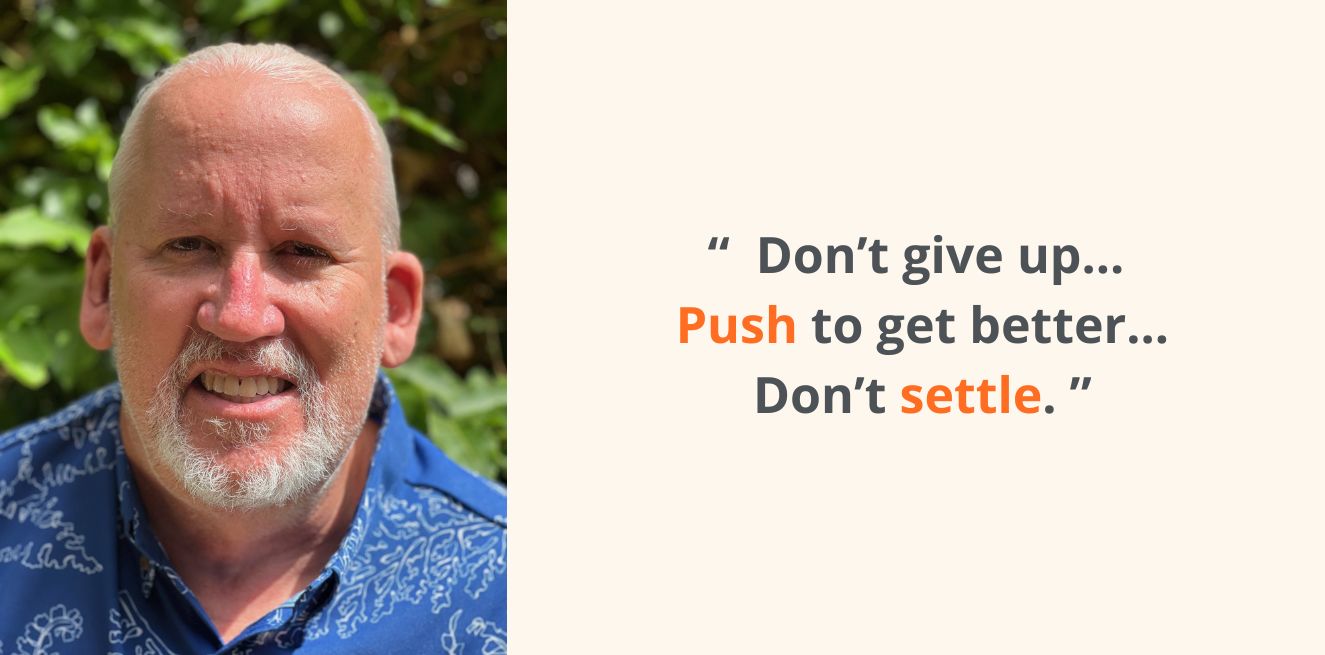
To others, I hope this gives inspiration to not give up, to push to get better, and don’t settle.